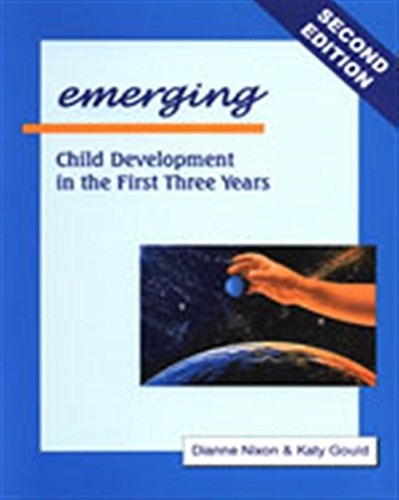
Emerging Child Development in the First Three Years by Dianne Nixon - USED
Emerging Child Development in the First Three Years by Dianne Nixon - USED
Regular price
$12.00 AUD
Regular price
RRP
Sale price
$12.00 AUD
Shipping calculated at checkout.
As our knowledge of young children grows, so does our awareness of the importance of the first few years of life. This book is written for those who work with children in the first three years of their lives, and for anyone who wants to understand more about what researchers and theorists have to tell us about this age group. It contains nine chapters. Chapter 1, "Overview of Theories," explores Piaget's theory of cognitive development, Vygotsky's theory of language and cognition, Bruner, the constructivists and behaviorists, and Erikson's theory of social-emotional development. Chapter 2, "The Neonate," describes physical and emotional features of the very young infant, covering such topics as reflexes, senses, cycles, temperament, bonding, and the influence of gender and race. Chapter 3, "The First Year of Life," describes development in gross and fine motor skills and cognitive, emotional, and social capabilities. Chapter 4, "Language Development," covers the sequence, theories, and application of theories of language acquisition. Chapter 5, "The Second Year of Life," is similar to Chapter 3, also exploring issues of autonomy versus shame and doubt. Chapter 6, "Play and the Development of the Child," presents a historical perspective, theories of play, and principles of play in the first three years. Chapter 7, "The Third Year of Life," is similar to Chapters 3 and 5. Chapter 8, "Inclusion of Children with Additional Needs," discusses various disabilities and abused children and presents strategies for active inclusion. Finally, Chapter 9, "Observing the Child," explores the need for observation, formal and practical observation methods, and ethical considerations. An appendix provides of checklist for various stages of development.
More Details
More Details
Condition: Acceptable
Publisher: Thomson/Social Science Press
Binding: Paperback
Publication: 1999
Pages:
Weight:
Themes: Family & Relationships,Parenting,Social Science,Children's Studies
Authers: Dianne NixonThomson/Social Science Press
Couldn't load pickup availability